

You cannot submit a page to ChatGPT or buy a place in its answers. To get cited, let OAI-SearchBot crawl your site, get your pages indexed by the search engines ChatGPT draws on, and publish pages that answer a specific question with checkable facts, a named author and clear limits. Then measure citations and referral traffic.
OpenAI states plainly that placement in ChatGPT search results is not guaranteed. What you can influence is a chain of conditions. Search engines and crawlers have to find and read the page first. Its content then has to fit the question the user asked. And the system needs a reason to link to this page over the others: a clear answer, verifiable facts, known authorship and little room for misreading.
So the work starts with technical access and ordinary SEO, and then moves to making your content easy to cite. Secret prompts and special tags play no part in it.
The short answer: what should you do?
To raise the odds that ChatGPT cites your site:
- Allow OAI-SearchBot in robots.txt and make sure your CDN or bot protection does not block it.
- Check that important pages open without a login, return a 200 status code, carry no noindex tag and are listed in your XML sitemap.
- Add the site to Bing Webmaster Tools and Google Search Console, submit sitemap.xml and set up IndexNow for new and substantially updated URLs.
- Build pages around real tasks your audience has instead of writing one page per keyword variant.
- Put a short, direct answer near the top of the page, then explain the method, limits, evidence and examples.
- Show the author, publication and update dates, sources, how numbers were calculated and who the company is.
- Add structured data that matches what is visible on the page.
- Measure visits tagged
utm_source=chatgpt.com, OAI-SearchBot requests in your server logs and actual citations across a fixed set of tracked prompts.
These steps make your site a more accessible and more useful source. None of them guarantees a citation, and OpenAI has not published a ranking formula you could copy as a checklist.
What does "getting into ChatGPT answers" mean?
People use the phrase for three different outcomes.
The first is a link in an answer that used web search. ChatGPT pulls current material from the web and shows the source next to a statement or in the Sources panel. This outcome is the clearest and the easiest to measure: the user sees a link, and you may get a visit.
A navigational link works differently. Someone asks for a company website, a documentation page or a specific article, and ChatGPT sends them to that URL. What decides it is an exact name, an unambiguous entity and a page that opens.
Then there is a mention without a link. The model may know a brand or a fact from data it saw earlier. You have almost no control over this and cannot reliably tie it to anything you changed recently. A mention also does not mean the model read the current version of your page.
This article is mostly about the first outcome, where your site is a checkable source in an answer that ChatGPT wrote after searching the web. According to OpenAI's help center, ChatGPT can search the web automatically when a question needs current information, and those answers can include links to the sources used.
How does ChatGPT find sources for an answer?
ChatGPT search does not work from a fixed list of preselected websites. When a user asks something, the system can rewrite the question into one or more narrower search queries and send them to its search providers.
It then gets results back, picks material, writes the answer and adds links where they are available and useful. OpenAI says ChatGPT search uses third-party search providers as well as content supplied directly by partners. Its help center has named Microsoft's Bing and Shopify among those providers. So your visibility in regular search is part of the route into ChatGPT answers, but it would be wrong to reduce the whole mechanism to Bing.
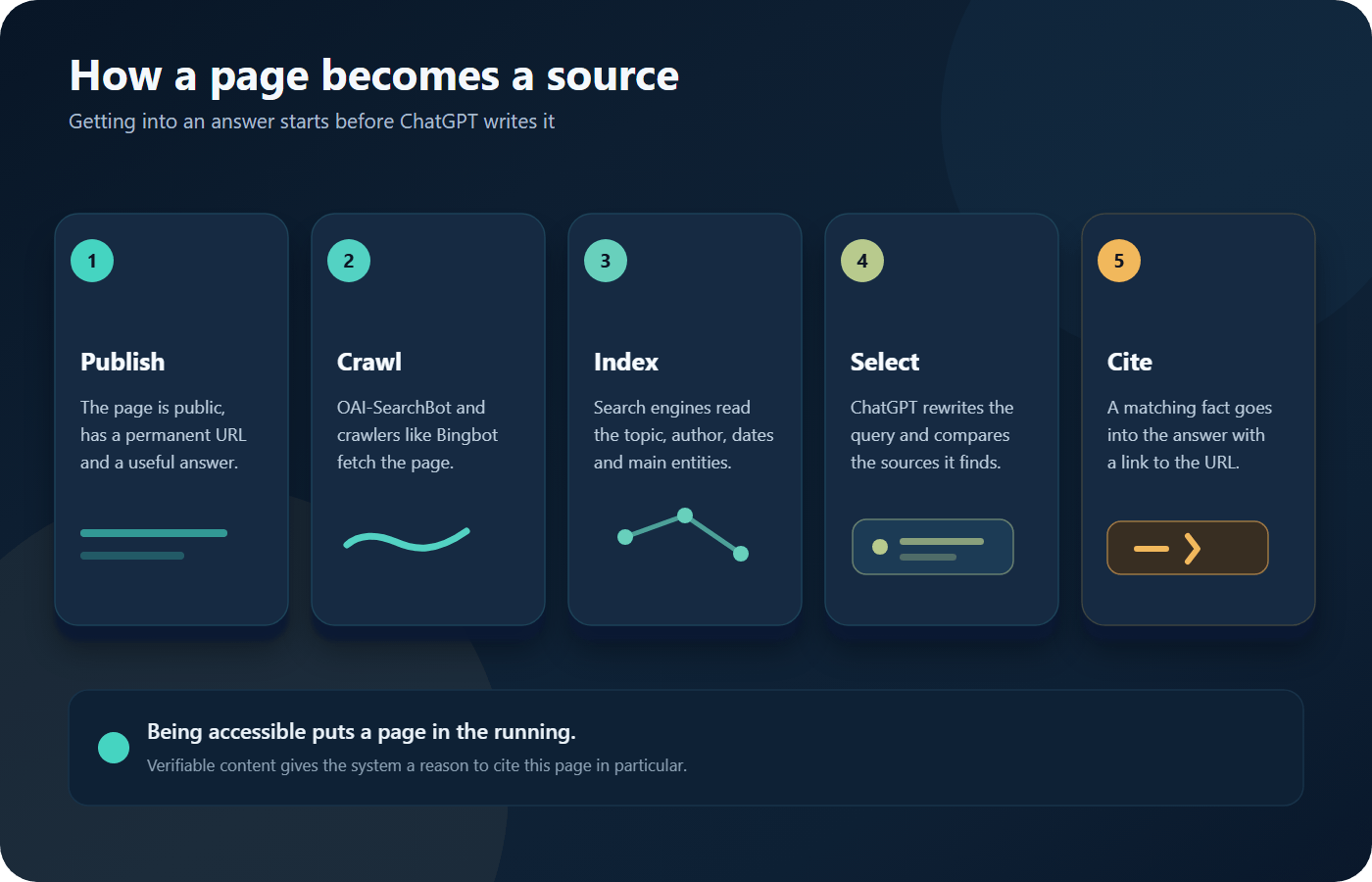
Figure 1. How a page gets from publication and the search index to a citation in a ChatGPT answer
A page has to pass two filters in a row.
The first is access. The crawler has to fetch the page, see the main text and understand that the URL is allowed for search. If the site answers with a 403, hides content behind a login or blocks crawling in robots.txt, a good article can stay invisible.
The second is fit. The page has to answer a specific question more precisely or more usefully than the alternatives. A reachable URL is only a candidate: the system compares several pages, and not every answer carries a link.
That is why I don't frame the job as "GEO instead of SEO." Basic SEO gets the page found, and the work on top of it makes the content easy to check, extract and cite. I cover the difference in more detail in what generative engine optimization is.
How is getting into ChatGPT different from regular SEO?
In classic search you compete for a position and a click on your snippet. In an AI answer, the user may get the main information without opening any page. The link goes to the material that helped support the answer or offers a useful next step.
| What we compare | Classic SEO | Visibility in ChatGPT answers |
|---|---|---|
| Immediate goal | A visible position and a click on the result | The page is used in the answer and linked as a source |
| Query shape | Often a short search phrase | A conversational question with conditions and follow-ups |
| Unit of optimization | A page and a cluster of queries | A page, its specific claims and entities |
| What gets in the way | Indexing problems, weak match to the query, duplicates | All of that, plus vague conclusions, unsupported facts and confused entities |
| Main metrics | Impressions, rankings, clicks, conversions | Citations, source pages, visits from ChatGPT, conversions |
The usual SEO work still counts. Good site architecture, internal links, indexable HTML, authoritative mentions and a precise match to what the user wants help in both channels.
Step 1. Which questions should your site be the source for?
"We want to show up in ChatGPT" is too broad to act on. The system answers one person's specific question.
List the situations where your experience is genuinely useful. For each one, write down:
- who is asking;
- what decision they are making;
- what constraints they mention;
- which facts they need to check;
- what they will ask after the first answer;
- which page on your site can back up the conclusion.
The query "which CRM should I choose" is nearly useless as a brief for a single article. "Which CRM fits a manufacturer with a 40-person sales team that needs a NetSuite integration" sets criteria for comparison. You can answer it with a selection method, a table of limitations, a description of integrations and a case study someone can verify.
You do not need a separate URL for every long phrasing. That tactic quickly produces near-identical pages that compete with each other and add almost nothing new. Combine related questions into one substantial piece, and cover narrow commercial scenarios on service, solution or industry pages.
A simple intent map looks like this:
| User intent | Page that fits |
|---|---|
| Understand a term or method | An explainer that states where the method applies |
| Compare approaches | A table of criteria and a look at the trade-offs |
| Choose a vendor or product | A service page with price, process and limitations |
| Check a claim | Research, a methodology, a case study with source data |
| Solve a problem | A step-by-step guide and troubleshooting |
What you want from this step is a list of decisions for which your site can offer the best first-hand material. A long keyword list does not tell you that.
Step 2. How do you open your site to OAI-SearchBot?
OpenAI uses a dedicated crawler, OAI-SearchBot, for ChatGPT's search features. OpenAI's crawler documentation keeps it separate from GPTBot, which collects content that may be used to train models. Sites that disallow OAI-SearchBot are not shown in ChatGPT search answers, though they can still appear as navigational links.
If you want to appear in ChatGPT search but do not want your content used for training, you can set the two apart:
1User-agent: OAI-SearchBot2Allow: /3 4User-agent: GPTBot5Disallow: /6 7Sitemap: https://example.com/sitemap.xml
Adapt the example to your site. Before you change robots.txt, check the rules you already have for directories, admin pages, URL parameters and other crawlers.
Allowing the bot in robots.txt is not enough on its own. Also check that:
- your CDN, WAF and bot protection do not answer OAI-SearchBot with a 403;
- network rules do not block OpenAI's published IP ranges;
- the important page opens without signing in;
- the server returns a 200, not a chain of broken redirects;
- the HTML has no meta robots noindex;
- the canonical tag points to the right main version of the URL;
- the main text is in the HTML the crawler receives, or reliably available after rendering;
- the mobile and desktop versions do not contradict each other.
OpenAI also asks site owners to allow requests from the published SearchBot IP ranges. This matters most on sites behind Cloudflare, Akamai and similar protection, which can mistake legitimate crawling for suspicious automated traffic.
After a robots.txt change, OpenAI says it can take about 24 hours for its systems to adjust. That figure covers the robots.txt signal only and says nothing about when a new page will be crawled, indexed or cited. Crawler access, response codes, rendering and markup are the job of technical GEO.
What is the difference between the three OpenAI bots?
| User agent | What it is used for | Affects inclusion in ChatGPT search |
|---|---|---|
| OAI-SearchBot | Automatic crawling for search features | Yes, it is the main control for search |
| GPTBot | Collecting content that may be used to train models | No, it is configured separately |
| ChatGPT-User | Visiting a page when a user asks ChatGPT to | No, it is not used to decide search inclusion |
Blocking GPTBot by itself should not remove your site from ChatGPT search. The trouble starts when robots.txt blocks all AI bots in one group, or a network filter cannot tell one user agent from another.
Step 3. Can search engines find the page?
ChatGPT search relies on search partners, so technical SEO cannot stop at the OpenAI bot.
Add the site to Bing Webmaster Tools, and keep Google Search Console in order too, since Google AI Overviews, AI Mode and Gemini draw on the Google index. In both, check:
- the indexing status of priority URLs;
- crawl errors;
- blocked resources;
- how your XML sitemap is processed;
- duplicates and unexpected canonicals;
- queries your pages already get impressions for;
- inbound links and site structure.
Microsoft recommends keeping a sitemap.xml even when IndexNow is set up. The sitemap gives the search engine the full list of canonical pages, while IndexNow reports that a specific URL was added, changed or removed.
Give every URL in sitemap.xml an honest lastmod: the date the page content last changed, not the time the file was regenerated. Bing says it ignores changefreq and priority for crawling and ranking, while an accurate lastmod helps it schedule recrawls.
IndexNow is useful for news, prices, stock levels, schedules and expert content you update. The IndexNow FAQ warns that submitting a URL tells the search engine about a change but does not guarantee indexing. Google is not among the participating engines, so for Google you still rely on the sitemap and Search Console.
The technical baseline also includes:
- one permanent URL for each main topic;
- readable addresses without random IDs;
- internal links to important pages;
- no endless combinations of filter URLs;
- correct handling of removed and moved pages;
- fast loading, with the main answer not buried under a heavy interface;
- text that is readable as text, not only inside an image or video.
If a URL stays out of the regular index because of a duplicate, a technical error or thin content, it is too early to expect a steady citation in ChatGPT.
Step 4. How do you make a page easy to answer from?
A page can be technically perfect and still lose to a source that answers the question faster. Reworking existing pages around that answer is page optimization for AI search.
Put the main point near the top. Do not open with the history of the market, a definition of the internet or a story about how fast technology changes. The reader should get the answer before they get tired of scrolling.
Good structure does not mean cutting the text into short "chunks" for a neural network. Google's 2026 guide to generative AI features in Search says there is no need to break content into tiny pieces for AI, and that you do not need new AI text files or Markdown versions to appear in Google Search. Structure is there for the reader:
- the H1 names the topic precisely;
- the lead says what the reader will get;
- H2s split the text along real subtasks;
- each term is defined where it is first used;
- tables are used for comparison, not decoration;
- conclusions come with their conditions;
- important data has a date, a unit and a source.
Imagine an editor has to lift one of your paragraphs and put it next to a link. Would it make sense without the five screens around it? Does it have a subject, an action, a condition and a stated limit?
A weak statement:
Our methodology significantly improves AI search performance.
A statement you can check:
The method checks four groups of signals: page access, indexing, how well the page answers the question, and citations. Changes are judged on the same set of queries before and after each update.
The second version promises no result that cannot be guaranteed, and it says what the specialist does and how you can check the work.
Step 5. What makes a page worth citing?
A summary of ten other articles rarely becomes the best source. Its main points already exist elsewhere, sometimes closer to the original.
Pages get cited when they reduce uncertainty. Material that does this includes:
- your own research, with the sample and period described;
- a comparison against criteria stated up front;
- instructions tested on a specific product version;
- a price table with a date and the terms;
- a case study with the starting point, the actions taken and how results were measured;
- a comment from a named specialist with their role;
- a calculator or a dataset;
- a photo, diagram or screenshot that shows the process;
- a precise explanation of a limitation competitors leave out.
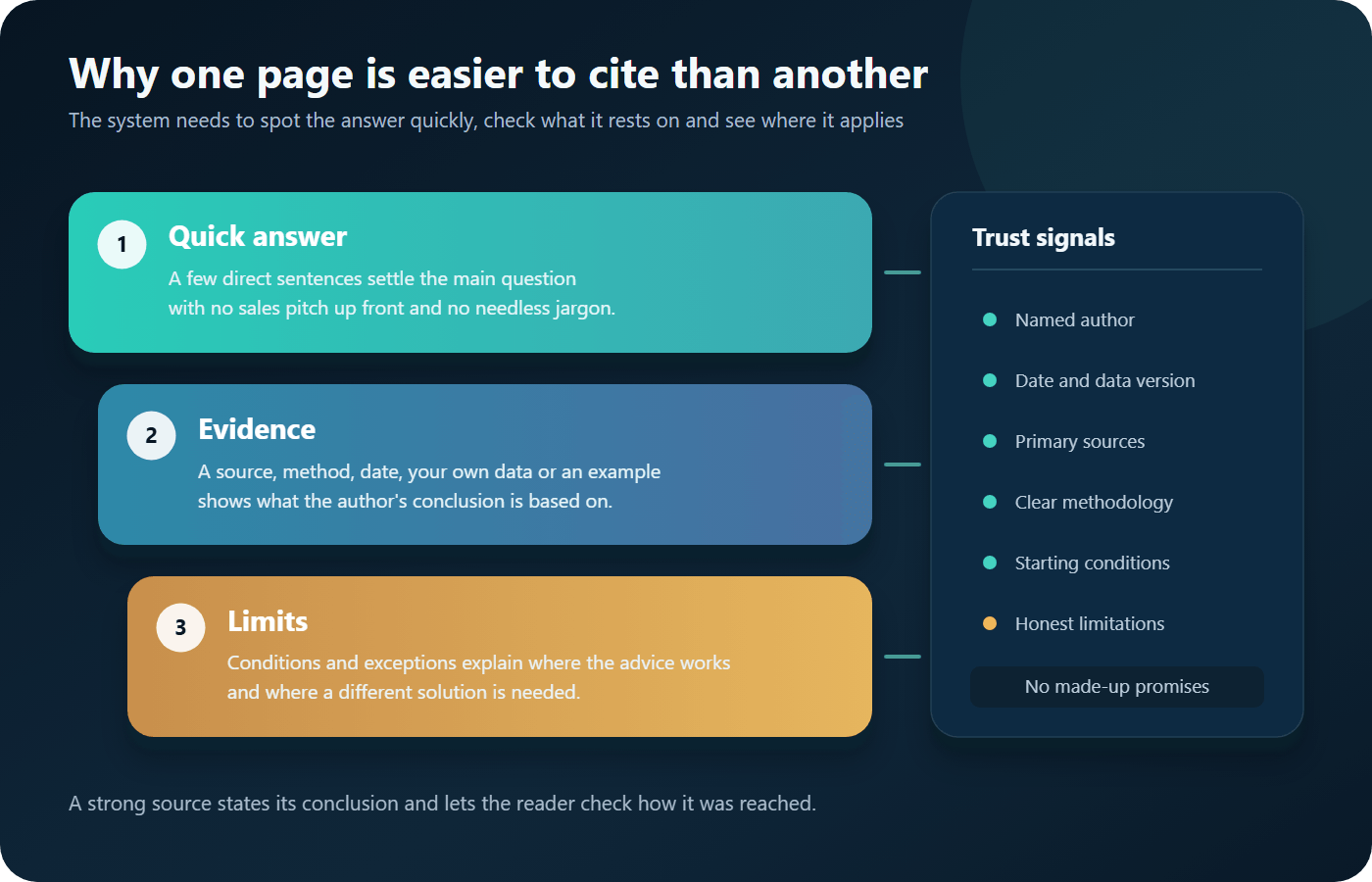
Figure 2. The three layers that make a page easier for a search system to check and cite
A strong page usually has three layers.
A quick answer. A few sentences that settle the main question, with no sales pitch in front of them.
Evidence. Data, a source, an example, a method or an explanation of cause and effect. When the author draws a conclusion, the reader should see what it rests on.
Limits. The conditions under which the advice works or stops working. This layer often separates expert material from an unconditional promise.
Test every substantive claim with a few questions: who established this, when, for what, using what method, and can the source be opened? If there is no answer, soften the claim or remove it.
Google's guidance on helpful, people-first content suggests a similar test: does the content offer original information and analysis, is it clear who wrote it, does it show real expertise, and does the reader leave with a complete answer? These are Google's recommendations, not published ChatGPT ranking factors. They are useful here because ChatGPT search runs on search infrastructure, and a page that can be checked is easier to use for a person and for any system that writes answers with links.
Step 6. How do you clear up confusion about authors, companies and products?
AI systems work with entities: people, organizations, products, addresses, events. If the homepage calls your company one thing, the contact page another, and your articles use an unexplained abbreviation, the system has a harder time matching the facts.
Make these consistent:
- the legal and public company name;
- address, phone, service area and hours;
- author names and job titles;
- product and plan names;
- links to official profiles;
- publication and last-updated dates;
- units, currency and whether prices include sales tax or VAT;
- terminology across a series of articles.
Create separate pages about the organization and about each author. Every article needs a visible byline, and the name should link to a profile that backs up the author's specialty. Do not credit an author with experience, projects or certifications they do not have.
Independent mentions also help search engines match an entity and judge its reputation. Buying empty placements, setting up fake rankings or sending out identical press releases is a bad idea, though: it adds noise and proves nothing.
Step 7. Does structured data help, and how much?
Structured data helps search engines recognize the page type, author, organization, image and dates explicitly. It is not a pass into ChatGPT and does not guarantee a citation.
An expert article can use Article or BlogPosting with these properties:
- headline;
- image;
- datePublished;
- dateModified;
- author;
- publisher;
- mainEntityOfPage.
A simplified JSON-LD example:
1{2 "@context": "https://schema.org",3 "@type": "BlogPosting",4 "headline": "How to get your website cited by ChatGPT: a step-by-step plan",5 "image": [6 "https://example.com/images/how-to-get-cited-by-chatgpt-1600x900.jpg"7 ],8 "datePublished": "2026-09-18T09:00:00-04:00",9 "dateModified": "2026-09-18T09:00:00-04:00",10 "author": {11 "@type": "Person",12 "name": "Author Name",13 "url": "https://example.com/authors/author-name/"14 },15 "publisher": {16 "@type": "Organization",17 "name": "Company Name",18 "url": "https://example.com/"19 },20 "mainEntityOfPage": {21 "@type": "WebPage",22 "@id": "https://example.com/blog/how-to-get-cited-by-chatgpt/"23 }24}
Replace the example with real data. The markup must match what a person sees on the page. Do not list an author who is not shown, a made-up rating or an update date when nothing changed.
For the homepage or the about page, use Organization or a more specific subtype. For other pages, choose markup that fits their actual content: Product, LocalBusiness, BreadcrumbList and other types that apply.
Google's Article structured data documentation recommends adding images, the author and dates so the search engine understands the article better. OpenAI has published no such requirement. Here the markup simply describes the page unambiguously to search infrastructure.
Step 8. How should your pages link into a topic cluster?
One long article should not try to answer every question a business has. When it mixes a definition, prices, choosing a vendor, a dozen industries and a detailed guide, no section gets the depth it needs.
Build a small topic cluster instead:
- an overview article explains the approach and the terms;
- a how-to guide shows the process;
- a comparison helps the reader choose an option;
- a service page describes the result, stages, price and limitations;
- a case study shows how the method was applied;
- the author and company pages explain why the source can be trusted.
Connect the pages with descriptive internal links. The reader should know where a link leads before clicking. "Read more" tells them nothing about the next page.
Do not create dozens of near-identical pages like "ChatGPT optimization for dentists", "for lawyers" and "for manufacturers" where only the industry name changes. A separate page earns its place when the industry really has different data, constraints, examples and buying process.
Step 9. How do you keep content factually current?
ChatGPT goes to web search precisely when a question may need current information. An outdated price, a discontinued feature or someone's old job title makes a page a weaker source.
Set a review schedule. How often depends on the type of data:
- prices, stock and schedules: often;
- interfaces and documentation: after each release;
- regulatory and financial topics: whenever the rules change;
- core explainers: when new facts appear or practice changes.
Change the date only after a real content edit. A short note on the page about what changed helps. The lastmod field in sitemap.xml should also reflect an actual content change.
Do not rewrite a working page from scratch just to get a new date. Find the outdated claim first, add a new source, tighten a limitation or improve the answer to a question that was covered poorly.
Step 10. How do you measure visibility in ChatGPT?
A ChatGPT answer has no single stable position. The wording of the question, the conversation so far, location, date and the sources available can all change the result. One manual query proves very little.
Split measurement into four levels.
1. Crawler access
Check your server logs:
- does OAI-SearchBot request robots.txt and your pages;
- which status codes it gets;
- whether it hits rate limits;
- whether it sees your current canonicals and redirects.
User agents can be faked, so when you investigate, match requests against OpenAI's published IP ranges.
2. Discovery and indexing
Use Bing Webmaster Tools and Google Search Console. Beyond whether a URL is indexed, check crawl errors, the canonical the engine selected, queries and the date of the last crawl.
Since February 2026, Bing Webmaster Tools has offered an AI Performance report in public preview. It shows citations, cited pages and grounding queries for Microsoft Copilot, AI summaries in Bing and some partner integrations. It is a useful extra signal, but you cannot treat it as a complete report on ChatGPT.
3. Citations across tracked prompts
Build a fixed list of questions, your tracked prompts, and run it on a schedule. For each run, record:
- the exact wording of the question;
- date, language and location;
- whether web search was used;
- which domains and URLs were cited;
- which statement each link supports;
- whether your brand appeared in the answer itself;
- how well the answer matched what the user wanted.
Keep the wording fixed between runs if you are tracking change over time. Put exploratory variants in a separate group. This is the routine I run for clients in AI visibility monitoring, across ChatGPT and the other AI systems that matter to them.
4. Visits and business results
OpenAI says it adds utm_source=chatgpt.com to referral links. Create a separate segment for this tag in GA4 or whatever analytics you use, and track:
- sessions and landing pages;
- leads, calls, sign-ups or purchases;
- conversion rate;
- revenue or the value of each lead;
- the share of new visitors;
- what users do after they arrive.
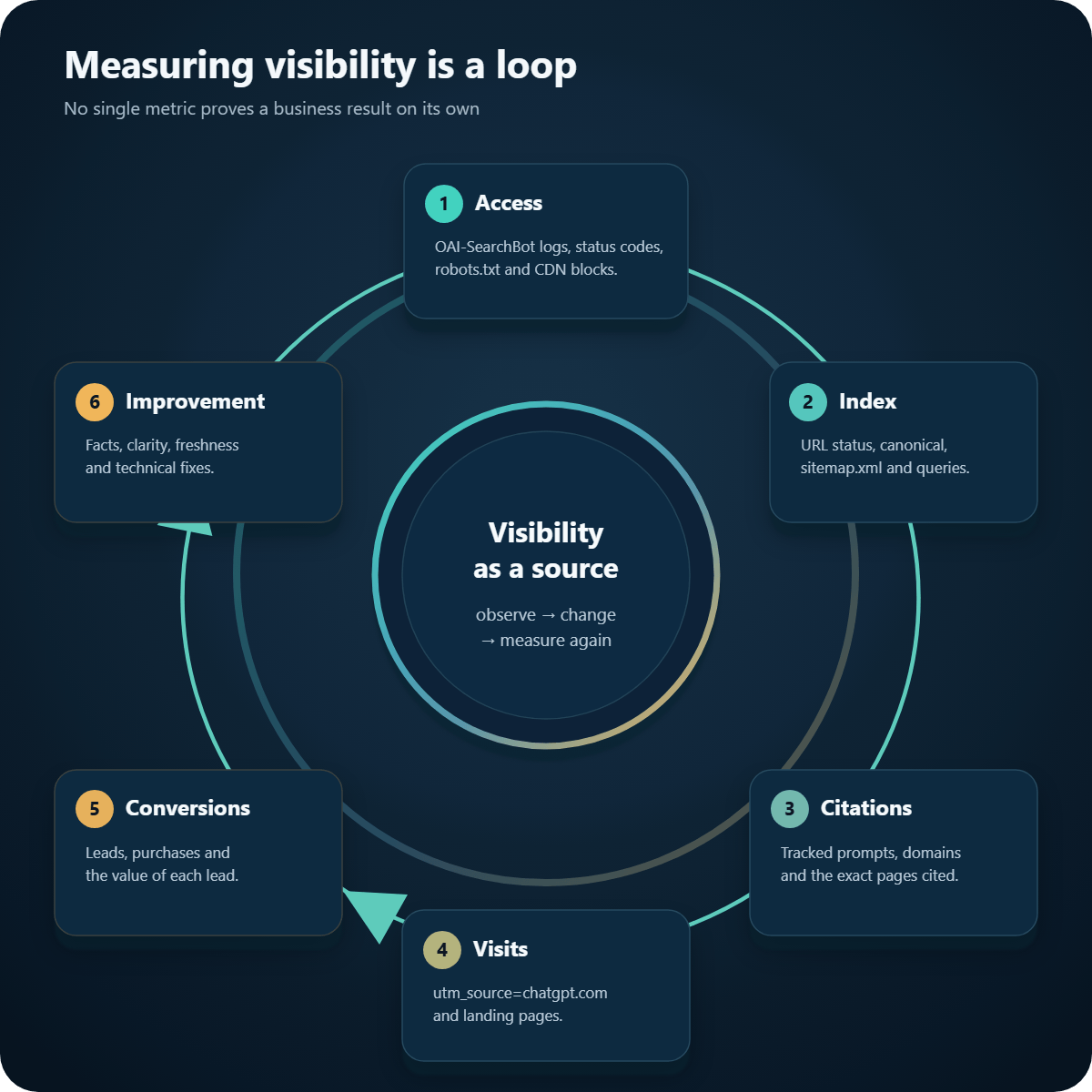
Figure 3. The loop for measuring and improving your visibility in ChatGPT answers
A citation without visits may still build awareness, but you should not invent a commercial effect for it. Tie the work to an action on the site that you can measure.
What does a 90-day plan look like?
Ninety days will not guarantee a place in answers, but they make a workable cycle, with enough time to fix technical problems, update priority pages and collect several comparable measurements.
Weeks 1–2: technical baseline and first measurement
- check robots.txt, noindex, canonicals, status codes and CDN blocks;
- add or verify the site in Bing Webmaster Tools and Google Search Console;
- update sitemap.xml with real lastmod values;
- set up IndexNow;
- check the logs for OAI-SearchBot;
- settle on a fixed set of 20–50 tracked prompts;
- record current citations and visits.
Weeks 3–6: the pages with the most potential
Focus on 5–10 URLs that already get impressions, hold expert material and match commercially important questions. It is too early to rework the whole site.
For each page:
- rewrite a weak intro into a direct answer;
- add the missing conditions and limitations;
- check the numbers and links;
- show the author and dates;
- add an original example, table or method;
- set up correct structured data;
- link the page to a service, a case study and the author profile.
Weeks 7–10: closing the gaps
See which competing sources get cited for your tracked prompts. Rather than copying their structure, work out what your page is missing: a primary document, a specific comparison, a recent date, a handy table or an answer to an objection.
Create a new URL only for a distinct user task. If the answer fits naturally on an existing page, update that page.
Weeks 11–13: re-measure and decide
Run the tracked prompts again under the same conditions. Compare:
- access and crawl frequency;
- indexing;
- the number of questions with a citation;
- how many different pages get cited;
- visits from ChatGPT;
- conversions;
- changes in regular search.
Then you can decide which pages to expand, which to merge and which are not worth further spending.
What usually does not work?
"Guaranteed placement in ChatGPT"
OpenAI states that placement is not guaranteed. A contractor can guarantee an audit, implementation, content and transparent measurement. They cannot guarantee the decision of an outside system.
Allowing GPTBot and forgetting OAI-SearchBot
These are separate settings. ChatGPT search needs OAI-SearchBot access. Permission to train does not replace search crawling.
Adding llms.txt and calling it done
OpenAI's instructions for search inclusion name OAI-SearchBot, robots.txt and access from the published IP ranges. llms.txt is not listed as a requirement or a ranking factor. Google's 2026 guide also says you do not need special AI files to appear in Google Search. You can try llms.txt as an experiment, but it is too early to build a strategy on it.
Publishing hundreds of similar articles
Mass-produced text without new data adds URLs but gives no one a reason to cite them. It also dilutes internal linking and makes it harder to pick the canonical page.
Hiding keywords and answers
Hidden text, pointless FAQs, lists of cities and repeated queries do not make a page more credible. They make it harder to read and can be treated as search spam.
Marking up what is not on the page
Schema.org markup describes what is already visible on the page. A fake author, rating, price or date will not turn a weak page into a reliable source.
Buying "mentions in AI answers"
No one can honestly sell a mention inside an answer. You can buy a placement on another site, but its effect depends on the quality of that site, the context, indexing and whether it matches a question someone will ask later.
Checklist: is your page ready for ChatGPT?
Technical access
- The URL opens without a login and returns 200.
- OAI-SearchBot is allowed in robots.txt.
- The CDN and WAF do not block OpenAI's published IP ranges.
- The page has no noindex.
- The canonical points to the right URL.
- The page is in sitemap.xml with an honest lastmod.
- Bing and Google see and index the canonical version.
- The main information is available as text.
Content
- The H1 states the question precisely.
- A direct answer comes first.
- Terms are explained where they first appear.
- Conditions and limitations are stated.
- Numbers have a source, a date and units.
- Comparisons use explicit criteria.
- The page adds its own value instead of retelling search results.
- The reader's next question is answered or leads to the right page.
Trust
- A real author is named.
- The author's profile backs up their specialty.
- Publication and update dates are visible.
- The company, product and contacts are named the same way on every page.
- External sources open and support the claims next to them.
- Structured data matches the visible content.
Measurement
- A
utm_source=chatgpt.comsegment is set up. - OAI-SearchBot logs are reviewed.
- There is a fixed set of tracked prompts.
- The specific cited URLs are recorded.
- Citations are tracked apart from visits and conversions.
- A baseline was saved before any changes.
Frequently asked questions
Can I guarantee my website gets into ChatGPT?
No. Any public site can take part in ChatGPT search, but OpenAI does not guarantee placement. You can make the site technically accessible and your pages more useful. Which source gets picked is up to the search system.
Do I need to allow GPTBot?
For search visibility, allowing OAI-SearchBot is enough. GPTBot relates to possible model training and is controlled separately.
Does ChatGPT use only Bing?
There is no basis for reducing it to one engine. OpenAI refers to third-party search providers and partner content. Its help center has named Microsoft and Shopify, and the list and roles of providers can change.
Does schema.org markup help you get cited?
Structured data helps search engines understand a page more precisely, but OpenAI does not name it as a citation factor. I treat markup as part of technical clarity rather than a separate GEO trick.
Do I need an llms.txt file?
OpenAI's public instructions do not list it as a requirement for ChatGPT search. Set up OAI-SearchBot access, indexing, sitemap.xml, internal links and substantial pages first.
How many articles do I need to publish?
There is no standard number. Five pieces with your own data and clear tasks can do more than a hundred similar texts. Size the plan by the gaps in what your audience asks about rather than by a publishing quota.
When will I see results?
OpenAI only gives an approximate time for robots.txt changes to take effect: about 24 hours. There is no public timeline for crawling a page, for it to appear with search partners or for it to be cited. Judge the work by a series of comparable measurements rather than by one query the next day.
Where should you start tomorrow?
Do not rewrite the whole site for AI. Take ten commercially important questions and match each to an existing URL. Then check robots.txt, OAI-SearchBot access, indexing in Bing and Google, and the content of those pages.
If a page is accessible but gives no checkable answer, add evidence and state where the advice applies. If a good page is not being crawled, fix the technical cause first. Sorting pages this way quickly shows whether the problem is access, content or trust.
After 90 days you should have a clear picture: which questions matter to the business, which pages are used as sources, what changed, and whether citations turned into visits and leads.
If you would rather not build this routine yourself, book an AI visibility audit with Izotov Agency. I check which questions get your brand named by ChatGPT and other AI systems and who shows up instead, find the technical causes and weak pages, and give you a 30–90 day plan.